

Questions to Ask Before Choosing a Cosmetic Factory
2026-08-04 | Beauty Insights
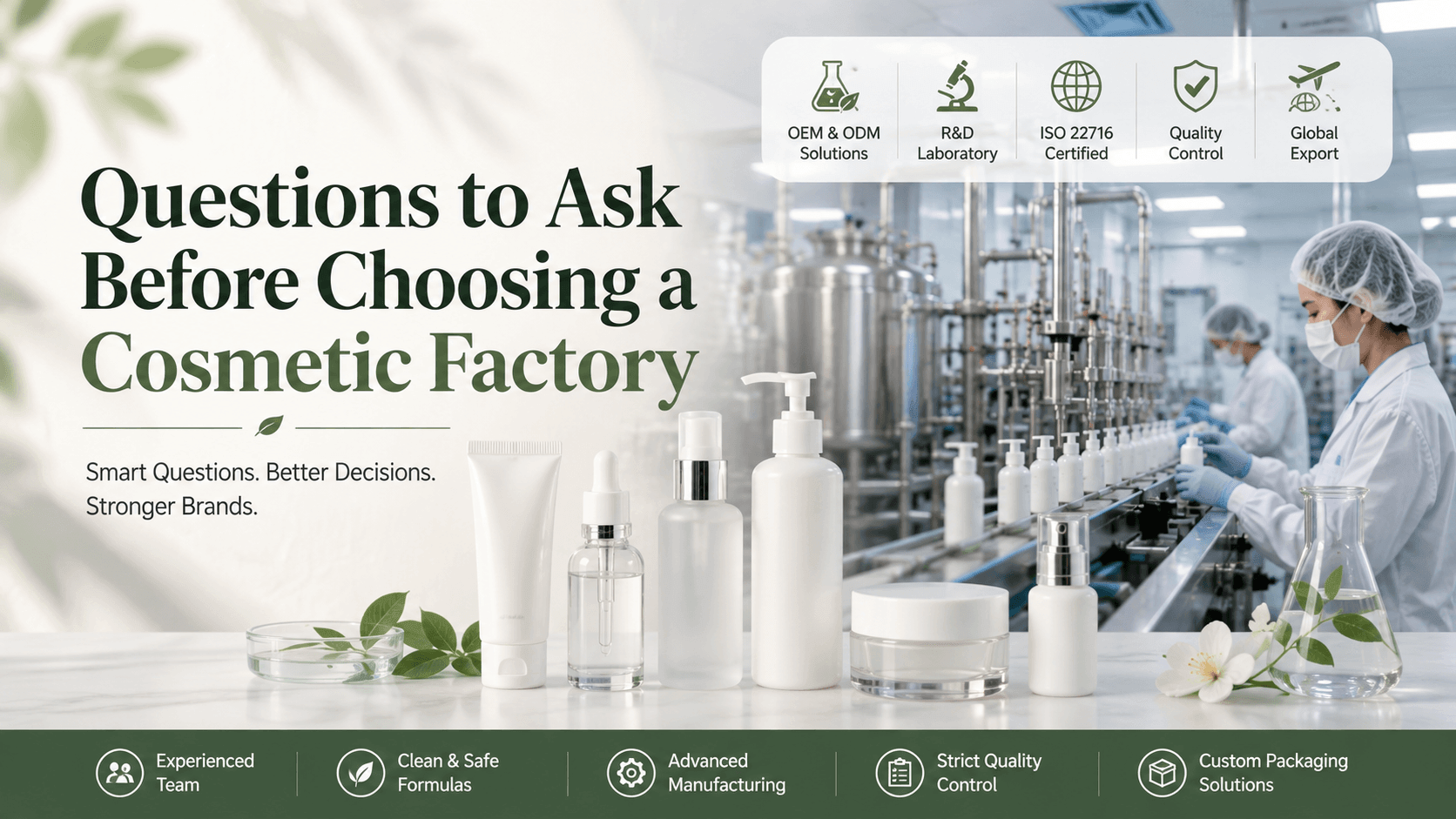
Launching a beauty brand is exciting, but choosing the right cosmetic factory is one of the most important decisions you'll make. Whether you're creating a private label skincare line, developing custom formulations, or expanding an existing product range, your manufacturing partner will directly influence your product quality, brand reputation, delivery timelines, and long-term business growth.
While many factories advertise similar services, their capabilities can vary significantly. Some specialize in private label products, while others excel in OEM formulation development or large-scale contract manufacturing. Asking the right questions before making your decision can help you avoid costly mistakes and establish a reliable long-term partnership.
This guide outlines the essential questions every beauty brand should ask before choosing a cosmetic factory.
1. Does the Cosmetic Factory Meet International Quality Standards?
The first thing to evaluate is whether the factory operates under internationally recognized manufacturing standards.
Ask if the manufacturer holds certifications such as:
· ISO 22716 (Cosmetic GMP)
· GMPC
· ISO 9001
· FDA Registration (where applicable)
· BSCI or SEDEX
· COSMOS or ECOCERT for natural and organic products
These certifications demonstrate that the factory follows standardized quality management systems and production procedures, helping ensure product consistency and regulatory compliance for global markets.
2. Can They Develop Custom Formulas?
Every beauty brand has different goals.
Some businesses prefer ready-to-market private label products, while others require exclusive formulations to differentiate themselves from competitors.
Ask the manufacturer:
· Can you customize active ingredients?
· Can fragrances and textures be modified?
· Do you offer exclusive formulas?
· How experienced is your R&D team?
· Can you develop trend-driven ingredients such as PDRN, peptides, ceramides, or probiotics?
A manufacturer with strong research and development capabilities can support your brand as market trends evolve.
3. What Are the Minimum Order Quantities (MOQ)?
MOQ has a significant impact on inventory costs and launch strategy.
Important questions include:
· What is the MOQ per SKU?
· Does customized packaging require a higher MOQ?
· Are mixed SKU orders available?
· Can startups place smaller trial orders?
· How does MOQ change for custom formulations?
Flexible MOQ options allow emerging brands to enter the market with lower risk while maintaining professional product quality.
4. How Does the Factory Control Product Quality?
Quality assurance should be built into every production stage—not just the final inspection.
Ask about their quality control process, including:
· Raw material inspection
· Production monitoring
· Stability testing
· Microbiological testing
· Finished product inspection
· Batch traceability
Reliable cosmetic manufacturers should have documented quality control procedures and provide testing reports when required.
5. What Packaging and Design Services Are Available?
Packaging often influences purchasing decisions as much as the product itself.
Ask whether the factory can provide:
· Custom packaging development
· Label design
· Bottle sourcing
· Sustainable packaging
· PCR materials
· Printing services
· Artwork support
Working with a manufacturer that offers one-stop packaging solutions can simplify product development and reduce project timelines.
6. Can the Factory Grow with Your Brand?
Your first production run may be small, but successful brands often scale quickly.
Before choosing a manufacturer, ask:
· What is your monthly production capacity?
· What are your average lead times?
· Can production capacity increase during peak seasons?
· Do you have experience exporting globally?
· How do you handle large-volume orders?
A scalable manufacturing partner will help support your business as demand grows.
7. What Markets Do They Currently Serve?
Factories with international export experience usually have a stronger understanding of different market regulations and consumer preferences.
Ask whether they currently manufacture products for:
· North America
· Europe
· Southeast Asia
· Australia
· Middle East
Experience with international distributors, retailers, and beauty brands often reflects stronger production management and regulatory expertise.
8. How Transparent Is Their Communication?
Excellent communication is one of the biggest indicators of a reliable manufacturing partner.
Evaluate:
· Response speed
· Technical knowledge
· Sample progress updates
· Production reports
· Project management
· After-sales service
A responsive manufacturer helps prevent misunderstandings and keeps projects on schedule.
9. Do They Offer OEM, ODM, or Private Label Manufacturing?
Understanding the manufacturer's business model is essential.
OEM (Original Equipment Manufacturing)
Your brand provides the concept and specifications, while the factory manufactures the products.
ODM (Original Design Manufacturing)
The factory develops formulations and product concepts that can be customized with your branding.
Private Label
Ready-made formulations packaged under your brand with minimal development time.
Choosing the right manufacturing model depends on your budget, timeline, and desired level of product differentiation.
10. Are They Focused on Long-Term Partnerships?
The lowest price doesn't always deliver the greatest value.
A reliable cosmetic factory should become a strategic partner by offering:
· Continuous product innovation
· Market trend recommendations
· Regulatory support
· Packaging upgrades
· Formula improvements
· Stable production planning
Long-term partnerships often lead to faster product launches, better pricing, and stronger brand growth.
Final Thoughts
Selecting the right cosmetic factory is about much more than comparing prices. The ideal manufacturing partner combines strong research and development capabilities, international quality certifications, strict quality control systems, flexible manufacturing solutions, and responsive customer support.
By asking these questions before making your decision, you'll reduce sourcing risks, improve product quality, and build a partnership capable of supporting your beauty brand for years to come.
Whether you're launching your first skincare line or expanding an established cosmetics business, investing time in choosing the right OEM cosmetic manufacturer is one of the smartest decisions you can make.
Frequently Asked Questions
How do I choose a reliable cosmetic factory?
Look for manufacturers with international certifications, strong R&D capabilities, quality control systems, flexible MOQ options, and transparent communication.
What certifications should a cosmetic manufacturer have?
Common certifications include ISO 22716, GMPC, ISO 9001, FDA Registration (where applicable), BSCI, SEDEX, COSMOS, and ECOCERT.
What is the difference between OEM and private label cosmetics?
OEM manufacturing creates products according to your specifications, while private label products use existing formulations branded with your company name.
Can startups work with cosmetic manufacturers?
Yes. Many cosmetic manufacturers now offer flexible MOQs and private label solutions designed specifically for startups and emerging beauty brands.
How important is product quality control?
Quality control is essential to ensure product safety, consistency, regulatory compliance, and long-term consumer trust.
Suggested Internal Links:
· How Leading Beauty Brands Choose the Right OEM/ODM Cosmetic Manufacturer
· OEM Cosmetic Manufacturing Process Explained: A Complete Guide for Beauty Brands
Suggested External References
· ISO 22716 – Cosmetics Good Manufacturing Practices
https://www.iso.org/standard/36437.html
· U.S. Food & Drug Administration (FDA) – Cosmetics
https://www.fda.gov/cosmetics
· Personal Care Products Council (PCPC)
https://www.personalcarecouncil.org/
· Cosmetics Europe
https://cosmeticseurope.eu/
· Cosmetic Ingredient Review (CIR)
https://www.cir-safety.org/
Related News
Join Us at the 137th Canton Fair - Visit Soho's Booth
👉 Contact us now to secure your slot or request a catalog: [Email: sales@yzsohocosmetic.com Website: www.yzsohocosmetic.com] PHASE 2: Booth No. 20.2K 03-04 Date: 2025.04.23-2025.04.27 PHASE 3: Booth No. 9.1C 01-02 Date: 2025.05.01-2025.05.01
Introducing the ECOPPEAL SHIMMER GLITTER STICK – Where Clean Beauty Meets Lasting Glow
Sustainable. Versatile. Effortlessly luminous.
Canton Fair 2026 | Meet Us in Guangzhou
We’re pleased to invite you to connect with us at the China Import and Export Fair (Canton Fair) 2026 this May.
Get Your Free Quote Now
Free sample, Free design, Online meeting,Online factory inspection
Send Message