

PDRN vs Hyaluronic Acid: Which Ingredient Is Better for Modern Skincare?
2026-07-28 | Company News
PDRN vs Hyaluronic Acid: Which Ingredient Is Better for Modern Skincare?
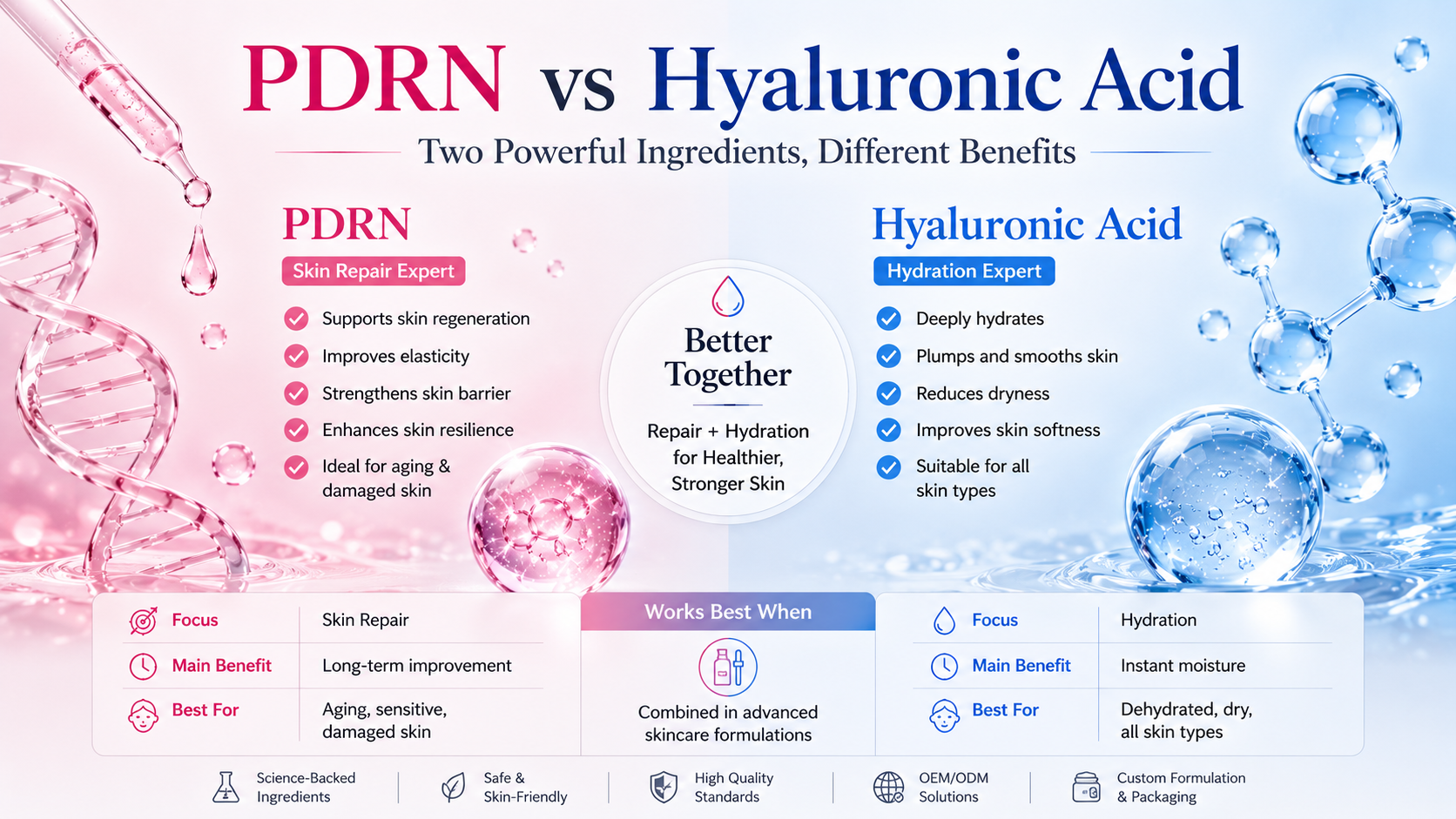
If you've been following the latest skincare trends, you've probably noticed two ingredients appearing in more and more premium beauty products: PDRN (Polydeoxyribonucleotide) and Hyaluronic Acid (HA).
While Hyaluronic Acid has been a staple ingredient in skincare for years, PDRN has quickly gained attention for its skin-repairing potential. As more brands develop science-backed formulations, a common question arises:
Is PDRN better than Hyaluronic Acid?
The answer is that they serve different purposes. Rather than competing with each other, these two ingredients complement one another and are increasingly used together in advanced skincare formulations.
What Is PDRN?
PDRN is an active ingredient known for supporting the skin's natural renewal process. Originally studied in regenerative medicine, cosmetic-grade PDRN is now widely used in high-end skincare products designed to improve skin appearance and strengthen the skin barrier.
In today's beauty industry, many manufacturers also offer plant-based or vegan-inspired PDRN alternatives, making the ingredient more suitable for global cosmetic markets.
Key benefits of PDRN include:
· Supporting skin recovery
· Improving the appearance of fine lines
· Enhancing skin elasticity
· Strengthening the skin barrier
· Promoting smoother, healthier-looking skin
Because of these benefits, PDRN is commonly found in serums, ampoules, facial creams, sleeping masks, and post-treatment skincare products.
What Is Hyaluronic Acid?
Hyaluronic Acid is one of the most recognized moisturizing ingredients in cosmetics. Naturally found in the skin, it has an exceptional ability to retain water, making it highly effective for improving hydration.
Unlike PDRN, which focuses on skin repair, Hyaluronic Acid primarily works by attracting and holding moisture within the skin.
Its key benefits include:
· Deep hydration
· Improving skin softness
· Reducing the appearance of dehydration lines
· Providing a plumper complexion
· Suitable for almost every skin type
Because of its versatility, Hyaluronic Acid remains a core ingredient in moisturizers, facial masks, toners, lotions, and serums.
PDRN vs Hyaluronic Acid: What's the Difference?
Although both ingredients improve overall skin quality, they achieve their results through different mechanisms.
|
PDRN |
Hyaluronic Acid |
|
Supports skin repair |
Provides deep hydration |
|
Focuses on long-term skin improvement |
Delivers immediate moisture |
|
Popular in premium anti-aging products |
Essential daily skincare ingredient |
|
Helps improve skin barrier |
Helps maintain skin hydration |
|
Common in regenerative skincare |
Common in moisturizing products |
Simply put, PDRN helps improve how the skin functions, while Hyaluronic Acid helps maintain optimal moisture levels.
Which Ingredient Should Beauty Brands Choose?
For skincare brands developing new products, choosing the right ingredient depends on the product's positioning.
If your goal is to develop:
· Repair-focused skincare
· Premium anti-aging collections
· Barrier-repair products
PDRN may be an ideal ingredient.
If your focus is:
· Daily moisturizing
· Universal skincare
· Lightweight hydration
Hyaluronic Acid remains one of the best choices.
However, many successful beauty brands no longer choose one over the other.
Instead, they combine both ingredients to create more comprehensive skincare solutions.
Why More OEM Manufacturers Combine PDRN and Hyaluronic Acid
From a formulation perspective, these ingredients work extremely well together.
Hyaluronic Acid provides immediate hydration, giving consumers an instant feeling of softer, smoother skin.
PDRN supports the skin over time by helping improve its overall condition and resilience.
This combination allows brands to deliver both instant results and long-term skincare benefits, making products more attractive in today's competitive beauty market.
It is becoming increasingly common to find formulations that combine:
· PDRN + Hyaluronic Acid
· PDRN + Ceramides
· PDRN + Peptides
· PDRN + Niacinamide
· PDRN + Centella Asiatica
These combinations help brands create differentiated products with stronger consumer appeal.
Private Label Opportunities
As consumer demand shifts toward ingredient-focused skincare, more brands are introducing PDRN product lines through OEM and private label manufacturing.
Popular product categories include:
· PDRN Facial Serum
· PDRN Ampoule
· PDRN Repair Cream
· PDRN Sleeping Mask
· PDRN Eye Cream
· PDRN Sheet Mask
An experienced OEM cosmetic manufacturer can also customize fragrance, texture, active ingredients, packaging, and branding according to market positioning.
For emerging skincare brands, combining PDRN with Hyaluronic Acid offers an opportunity to create products that balance innovation, performance, and consumer familiarity.
Final Thoughts
Rather than asking whether PDRN is better than Hyaluronic Acid, a better question is how these two ingredients can work together.
Hyaluronic Acid continues to be one of the most effective ingredients for hydration, while PDRN represents the growing demand for skin repair and premium skincare innovation.
As beauty consumers become more knowledgeable about ingredients, formulations that combine hydration with skin recovery are expected to play an increasingly important role in the skincare market.
At Mango Daily Cosmetic, we help global beauty brands develop innovative OEM and private label skincare products featuring advanced active ingredients such as PDRN, Hyaluronic Acid, peptides, ceramides, and botanical extracts. From custom formulation and packaging design to large-scale manufacturing, our team supports brands in bringing high-performance skincare concepts to market efficiently.
Frequently Asked Questions
Is PDRN better than Hyaluronic Acid?
Not necessarily. PDRN focuses on skin repair, while Hyaluronic Acid provides hydration. They address different skincare needs.
Can PDRN and Hyaluronic Acid be used together?
Yes. Many premium skincare products combine both ingredients to deliver immediate hydration and long-term skin conditioning.
Which ingredient is better for anti-aging?
PDRN is often selected for repair-focused and anti-aging formulations, while Hyaluronic Acid helps improve skin hydration and temporarily smooth the appearance of fine lines.
References
· PubMed – https://pubmed.ncbi.nlm.nih.gov/
· American Academy of Dermatology – https://www.aad.org/
· Cosmetic Ingredient Review – https://www.cir-safety.org/
· CosmeticsDesign – https://www.cosmeticsdesign.com/
Related News
Join Us at the 137th Canton Fair - Visit Soho's Booth
👉 Contact us now to secure your slot or request a catalog: [Email: sales@yzsohocosmetic.com Website: www.yzsohocosmetic.com] PHASE 2: Booth No. 20.2K 03-04 Date: 2025.04.23-2025.04.27 PHASE 3: Booth No. 9.1C 01-02 Date: 2025.05.01-2025.05.01
Introducing the ECOPPEAL SHIMMER GLITTER STICK – Where Clean Beauty Meets Lasting Glow
Sustainable. Versatile. Effortlessly luminous.
Canton Fair 2026 | Meet Us in Guangzhou
We’re pleased to invite you to connect with us at the China Import and Export Fair (Canton Fair) 2026 this May.
Get Your Free Quote Now
Free sample, Free design, Online meeting,Online factory inspection
Send Message